 CityBuddy
 English
Things to Do in Tangier, Morocco
Photo made by MELIANI Driss on Pexels.com
When to visit
Plan your perfect trip to Tangier, Morocco
Get a complete travel plan built just for you in under 30 seconds, with daily routes, local food tips, budget estimates and more.
Are any of these especially important to you?
Select all that apply
Plan language: EnglishMost popular attractions in Tangier, Morocco
Among the most prominent things to do in Tangier, Morocco, is visiting the Caves of Hercules, 14 kilometers west of the city, where the visitor stands before a rock opening shaped like the continent of Africa. After that, head to Cape Spartel at the meeting point of the Atlantic Ocean and the Mediterranean Sea. Do not miss the Kasbah Museum for its view over the strait and its Andalusian gardens.
1. Caves of Hercules
A natural sea opening shaped like the map of Africa that captures the eye. You will watch the waves pierce the rock and hear the echo of water inside a vast hall.
Quick facts: Nearly a million visitors enter this cave annually to see an opening that resembles a map of the African continent to an astonishing degree. Remains of bones and pottery from the Paleolithic era were found inside, and legend has it that the Greek hero rested here after one of his exploits.
Highlights: The most beautiful moment you experience is at sunset, when a ray of sun pierces the arch and the walls and water turn into a moving golden painting. Sit low on the back platform and look through the opening from an angle close to the ground, and the full map of Africa appears while the echo of the waves resounds inside the chamber.
2. Cape Spartel
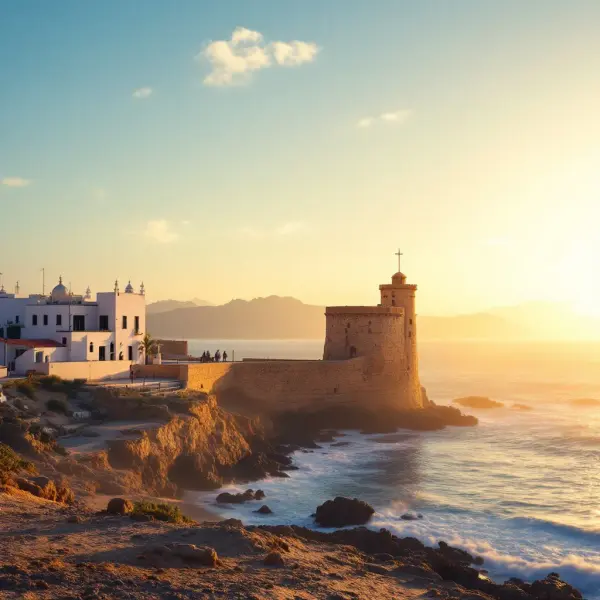
The end of the continent where two oceans meet in a breathtaking scene above tall rocks. Leap between the rocks and watch the sunset wash the white lighthouse in molten gold.
Quick facts: On this spot of the African coast, the waves of the Atlantic Ocean clash with the waters of the Mediterranean Sea at a rare meeting point. A white lighthouse 25 meters high has lit the passage since 1864, and the Moroccan sultan took part in funding it along with 16 countries whose international committee still manages it to this day.
Highlights: Guides often say the lighthouse here does not belong to a single country, as an international committee of 16 countries oversees it to this day, something you will not find at any other Moroccan lighthouse. At sunset, descend to the nearby cave to find a rocky opening shaped like the African continent through which a golden light enters, painting shifting colors on the damp walls above fierce waves.
3. Kasbah Museum
A whole world of Mediterranean civilizations awaits you within the halls of an ancient palace. You will walk among pieces thousands of years old and gaze from the balconies across the expanse of the sea strait.
Quick facts: The collection of this palace includes more than 800 archaeological pieces telling the story of the Mediterranean basin from prehistoric times to the nineteenth century. What amazes the visitor most is standing over a Roman mosaic depicting mythical scenes assembled from millions of colored pieces.
Highlights: From the high terrace on the southern facade, your gaze stretches over the entire Strait of Gibraltar, and on clear days you can see the shores of Spain only 14 kilometers away with the naked eye. In the inner Andalusian garden, a marble sundial still tells the time accurately after centuries, while a fountain of crimson marble flows among rows of palm trees and reflects its murmur on the ornate walls.
Have you heard of free walking tours?
After traveling to 30+ countries, there's one thing I wish someone had told me from day one, and it completely changed how I experience new cities.
Free walking tours. Yes, actually free. No credit card needed. No catch.
Local guide, 2-3 hours
Major sights, hidden gems, local stories
100% tip-based
Guides earn only tips, so they give their absolute best
You tip what feels right
At the end, just tip whatever you feel is right
I've done these in dozens of cities and they've been the highlight of almost every trip. If you're visiting Tangier, Morocco, do this on your first day. You'll thank me later.
4. Tangier American Legation Museum
The first American house on foreign soil and one of the rarest museums preserving a friendship two centuries old. You will wander among secret cabinets, ancient manuscripts, and Moroccan arts filling bright halls with the rhythm of the sea.
Quick facts: The first building gifted to the United States on foreign soil, presented by a Moroccan sultan in 1821 after the signing of a friendship treaty that remains in force to this day. Within its walls it holds an archive of more than 5,000 documents and manuscripts, and it is also the only American National Historic Landmark outside the United States.
Highlights: During World War II, the upper floors were used as a secret center for American agents disguised as a school for the blind under the code name "Port" to hide from the eyes of Axis agents. The dark iron safes and peepholes are still present in its walls, and beside them are more than 80 paintings made by self-taught Moroccans in colors that reflect the blue of the ceilings and doors.
5. Grand Socco
The natural entrance to the world of Mediterranean markets and the intertwined alleys of the old city. Stop at the fountain, drink mint tea, and set off toward the colorful maze of vendors in seconds.
Quick facts: An open square separating the walls of the old city from the streets of the modern city, crossed by a street connected directly to the port and the fish market. In its center rises a eucalyptus tree nearly a century old and over twenty meters tall, and it is the point where visitors receive their appointments.
Highlights: From the building of the Delegation Palace overlooking the square, King Mohammed V delivered the famous speech of April 9, 1947 in which he demanded Morocco's independence, and the square was officially named after that date. An hour before sunset, the overlooking cafes turn into an open theater where oyster vendors and chestnut carts move slowly under a golden light that touches the trunk of the giant tree.
6. Petit Socco
A square that can barely hold a hundred visitors, yet it condensed the secrets of an era of literature and espionage. A sip of coffee there takes you back to the time of great writers and the whispers of agents.
Quick facts: A square the size of a small waiting room, where writers from twenty nationalities passed through during its most mysterious era. The number of tables at its cafes does not exceed a few dozen, and yet it was a stage for exchanging coded messages between rival agents in the 1940s.
Highlights: At a cafe overlooking it, William Burroughs was drafting his novel "Naked Lunch" in the 1950s. The story goes that a pot of mint tea used to move between the tables of spies as an agreed-upon signal to change the meeting place on hot nights.
7. St. Andrew's Church
A quiet spot that tells of a conflict and a cultural dialogue spanning three centuries between the two shores of the Mediterranean. Within its walls, the ringing of bells mingles with the echo of the call to prayer, and the tombstones tell the stories of the travelers who settled here.
Quick facts: More than 300 graves surround its walls, among them the remains of consuls and spies whose bodies chronicled the multicultural history of this city. Light travels through its Moorish arches and paints a scene on colorful Victorian tiles, a sight you will not see in any other church around the world.
Highlights: Inside, Moroccan arches meet crosses in a rare harmony, as Islamic geometric ornaments frame the stained glass windows beside English oak benches. In the garden courtyard, a marble plaque carved by the British community immortalizes its dead since 1683, the oldest written testimony to the graves of foreigners buried in this land.
8. Perdicaris Park
A forest on the edge of the world overlooking two continents and two seas in a single view. An hour of wandering among cork trees concludes with a stunning view of the Strait of Gibraltar.
Quick facts: It stretches over 65 hectares of cork oak and eucalyptus forests, and from its summit you can see the Strait of Gibraltar and the coasts of Spain 14 kilometers away on clear days. Here history met adventure: the original owner of the land was kidnapped in 1904 in an incident that shook Western capitals, and the ocean spray still wets the paths to this day.
Highlights: From the upper rocky edge you can see with your own eyes the meeting point of the Atlantic Ocean and the Mediterranean Sea: white waves crashing from the west, and calm turquoise waters from the east. The forest paths preserve the story of the kidnapping of its owner in 1904 by a baron of the mountains, an incident that spilled ink in the world press for weeks and was sent by diplomats to Washington overnight.
9. Parc de la Mendoubia
A rare chance to see a tree that is four and a half centuries old in the heart of the old city. You will sit under its twisting shade while the tales of consuls, jinn, and sea ships hover around you.
Quick facts: The garden embraces a giant dragon tree over 450 years old, and its branching trunk mimics a miniature forest of twisting trunks. The walls surrounding it belong to an old palace that was the seat of the British delegation and then the French consulate across centuries of history.
Highlights: The branches of the dark tree extend over an area exceeding 20 meters, looking like two giant arms bending gently toward visitors. Locals tell that this tree is inhabited by a genie that guards the city, and many of them make a point of greeting it or leaving something small at its base before passing by it.
Where to Stay in Tangier, Morocco
Selected by City Buddy based on guest reviews and proximity to top attractions
Search all hotels in Tangier, MoroccoPowered by agoda
Traditional Sweet Dishes
Chebakia
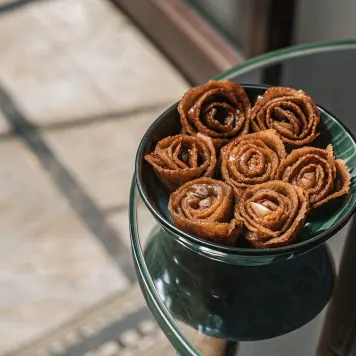
Chebakia is a flower shaped pastry fried and dipped in hot honey laced with orange blossom water. In Tangier it is the star of Ramadan tables, often served with mint tea after breaking the fast.

Kaab el Ghazal
Kaab el Ghazal, or gazelle horns, are crescent shaped cookies with a delicate filo crust and a rich almond paste filling scented with orange blossom water. The thin shell shows the filling through it, so bakers shape them freehand rather than with molds.

Sellou
Sellou is a no bake sweet made from toasted flour, almonds, sesame, and honey, pressed into a dense mound. In Tangier it is traditionally served to new mothers to help them regain strength after childbirth.
Traditional Savory Dishes
Tagine
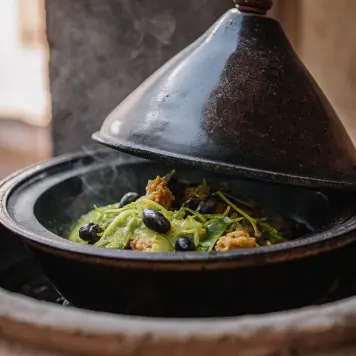
Tagine is a slow cooked stew, usually chicken with preserved lemon and olives, named after the cone shaped clay pot it simmers in. The conical lid traps steam so the dish needs very little added water.

Couscous
Couscous is steamed granules of semolina served with vegetables and meat, and in Morocco it is the traditional Friday family meal. Every Tangier home has its own spice blend that gives the dish a slightly different personality.
Bastilla
Bastilla is a famous pie from nearby Fez that layers spiced pigeon, almonds, and eggs inside crisp pastry, then is dusted with sugar and cinnamon. Its blend of sweet and savory flavors makes it the showpiece dish at Tangier celebrations.
Traditional Beverages

Moroccan Mint Tea
Moroccan mint tea, or atay b'naana, is green tea brewed with fresh spearmint and mountains of sugar. In Tangier it is poured from a height into small glasses to create a foamy top, which is a sign of respect to guests.
Moroccan Spiced Coffee
Moroccan coffee is brewed strong and finished with warming spices such as black pepper, cinnamon, and nutmeg. In the cafes of Tangier it is served in small cups with a glass of water, much like espresso is in Italy.
Fresh Orange Juice
Tangier is famous for its street juice stalls that squeeze bright, sweet oranges on the spot for a few coins. Morocco exports so many oranges that this sunny drink feels like the very taste of the city.
Frequently Asked Questions about Tangier, Morocco
Is the Moroccan city of Tangier safe for tourists?
How many days are suitable for visiting Tangier?
What is the best time of year to visit Tangier?
Is Tangier considered an expensive tourist city?
How can one get around inside the city of Tangier?
Get a PDF with the most popular attractions sent to your email
Get a PDF with all attractions, ratings, and tips. Perfect for offline use.
Most popular day trips
Chefchaouen
The blue painted city in the Rif Mountains, famous for its photogenic medina.
Asilah
Charming Atlantic coastal town with whitewashed walls and colorful murals.
Tetouan
UNESCO listed medina and Andalusi influenced architecture near the Rif.
Cap Spartel and Hercules Caves
Cape where the Atlantic meets the Mediterranean plus a legendary sea cave.
Larache
Quiet riverside town with Spanish colonial heritage and relaxed beaches.
Rent a car in Tangier, Morocco
Getting there
Train stations
Al Boraq high speed line to Casablanca, plus regional routes to Asilah, Larache, and Rabat
Ferry shuttle links to the port terminal and Casablanca line
From the airport take the regular ALSA bus or a grand taxi into the city center; the high speed train reaches Casablanca in about two hours.
Find flights to Tangier, Morocco
Click to get eSim for Tangier, Morocco
The easiest and most affordable way to get mobile internet wherever you travel.

Comments (8)
Always negotiate the taxi price before getting in. No meter will be running for you, and they get mad if you bring it up later.
Great food and the ocean breeze is unbeatable. We did get stopped by guide guys a couple times, just said no thanks, they moved on.
Tangier surprised me in a good way. The medina is total chaos, but sunset from Cafe Hafa with mint tea makes it all worth it.
Three nights was one too many honestly. The port area is pretty but the city overall is scruffier than I expected.
Most medina shops and cafe spots are cash only. ATMs here are few and foreigners often get declined. Stock up on dirham in town first.