 CityBuddy
 Lietuvių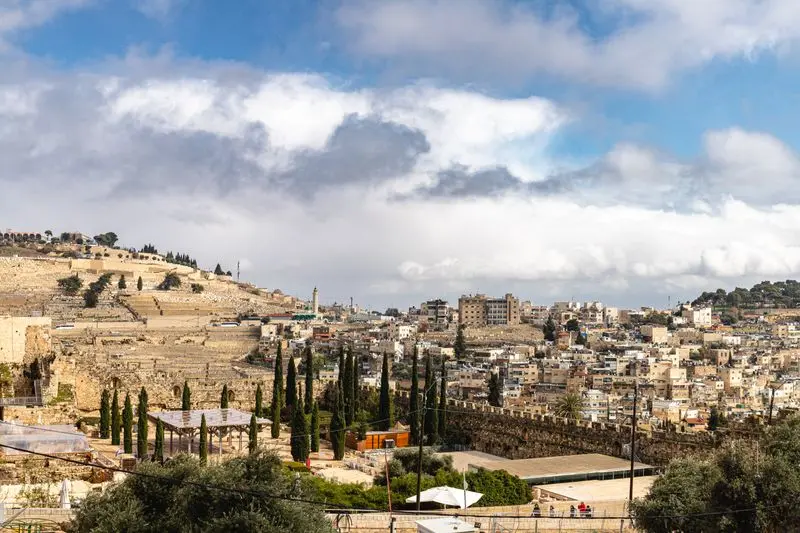
Ką veikti Jerusalem, Israel
Nuotrauką padarė Виктор Соломоник Pexels.com
Kada lankytis
Kada keliaujate į Jerusalem, Israel?
Pasirinkite datas ir kelionės stilių, kad gautumėte:
Ar kas nors iš šių jums ypač svarbu?
Pažymėkite visus, kurie tinka
Getting around
How do you want to move between places?
Plan language: LietuviųPopuliariausios lankytinos vietos Jerusalem, Israel
When considering things to do in Jerusalem, Israel, start at the Western Wall, where centuries of prayers are wedged between ancient stones. Just steps away, the Church of the Holy Sepulchre marks the site of crucifixion and resurrection, drawing pilgrims for over 1,600 years. Above it all, the golden Dome of the Rock dominates the skyline at 70 feet tall.
1. Western Wall
Touch stones that have stood for over 2,000 years and feel the pulse of a city's soul. Hear the murmur of prayers from strangers beside you, their hands pressed against sun-warmed limestone.
Greiti faktai: Each year, millions of tiny handwritten prayer notes are wedged into the ancient stone crevices of this holy site. The massive limestone blocks at the base weigh up to 600 tons each, heavier than a fully loaded Boeing 747.
Akcentai: On a quiet Thursday night, you might spot the elderly "Kotel Ladies" who have been cleaning the prayer nooks for decades, gently removing notes with ivory sticks so none are ever thrown away. Twice a year, the buried prayers are collected and buried in a ceremonial process on the Mount of Olives, a tradition that's continued unbroken for centuries.
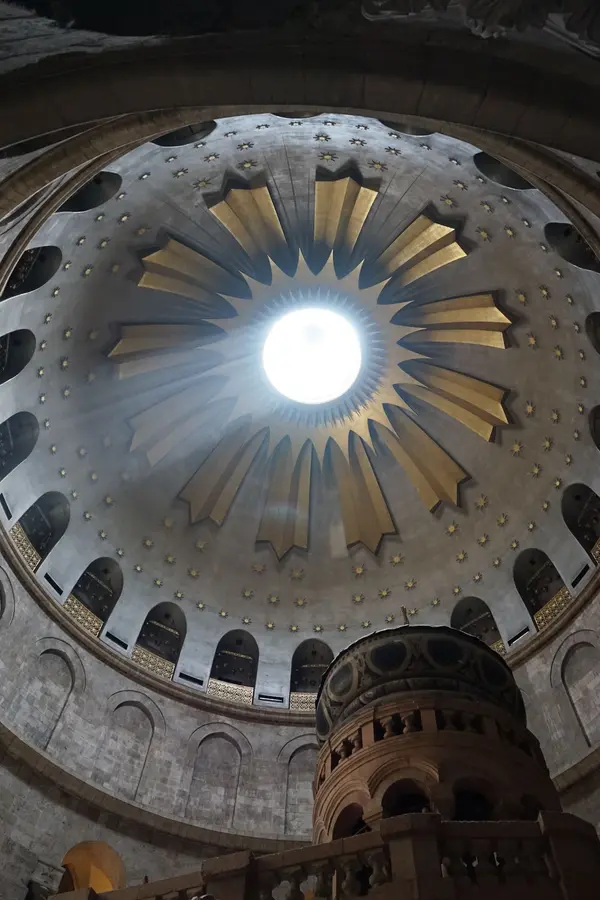
2. Church of the Holy Sepulchre
Stand at humanity's most contested religious site, where history's greatest story reaches its climax. Feel the cool stone beneath your fingers, hear echoes of ancient chants, and witness pilgrims in tears kneeling where they believe Christ rose from the dead.
Greiti faktai: The monumental rotunda soars 21.5 meters high, covering what Christians believe is the site of Jesus's crucifixion and burial. Control over the church is shared among six Christian denominations, whose monks once settled disputes by leaving the key with a Muslim family, a tradition that continues today.
Akcentai: Just inside the entrance, the Stone of Anointing draws pilgrims who kneel to touch and kiss its reddish limestone surface, smoothed by centuries of devotion. Above the Edicule, a small hole in the dome lets a shaft of sunlight beam directly onto the tomb at certain times of day, creating an almost theatrical glow.
3. Dome of the Rock
Stand on the Temple Mount where three faiths converge around a single rock carved into sacred history. You'll walk beneath 80,000 handmade tiles and a 24-karat gold dome that shines across Jerusalem's skyline.
Greiti faktai: Its golden dome spans 20 meters in diameter and rises 30 meters above the Foundation Stone, the rock from which Muslims believe Muhammad ascended to heaven. The exterior is covered with 80,000 tiles that were restored over seven years using original 16th-century Ottoman techniques.
Akcentai: Under the dome, the Foundation Stone still bears a natural indent that pilgrims once filled with gold dust as offerings, and the rock is said to hover without any support. The shrine's interior glows with 1.2 million mosaic tiles in deep blues, greens, and golds, and the light shifts across the marble floor throughout the day.
Ar girdėjote apie nemokamas pėsčiųjų ekskursijas?
Po kelionių į daugiau nei 30 šalių yra viena dalykas, kurį norėčiau, kad kas nors būtų pasakęs nuo pat pradžių, ir tai visiškai pakeitė mano požiūrį į naujų miestų pažinimą.
Nemokamos pėsčiųjų ekskursijos. Taip, tikrai nemokamos. Nereikia kreditinės kortelės. Jokio spąsto.
Vietinis gidas, 2-3 valandos
Pagrindinės lankytinos vietos, paslėpti perlai, vietinės istorijos
100% priklauso nuo arbatpinigių
Gidai uždirba tik iš arbatpinigių, todėl stengiasi iš visų jėgų
Paliekate arbatpinigius, kokius manote tinkamus
Pabaigoje tiesiog paliekate arbatpinigius, kokius manote tinkamus
Aš dalyvavau tokiuose daugelyje miestų ir tai buvo beveik kiekvienos kelionės akcentas. Jei lankotės Jerusalem, Israel, padarykite tai pirmą dieną. Vėliau man padėkosite.
4. Yad Vashem
Walk through a 180-meter prismatic museum tunnel that cuts through the mountain, telling the story of European Jewry through artifacts and personal films. You'll emerge into a sweeping view of Jerusalem's hills from the Hall of Remembrance.
Greiti faktai: Over 4.5 million names of Holocaust victims are stored in the Hall of Names, a circular space where their portraits and personal artifacts line the walls. The campus sits on Mount Herzl's western slope and includes the original 1957 Historical Museum, replaced in 2005 by a striking 4,200-square-meter prismatic structure.
Akcentai: The Hall of Names contains an underground repository with an estimated 2.5 million Pages of Testimony, handwritten forms submitted by survivors and families, leaving empty spaces for the unrecorded victims. A single candle flame reflects infinitely in a mirrored cone above, creating the illusion of stars in a dark sky as visitors stand in the center of the room.
5. Israel Museum
Stand face-to-face with the Dead Sea Scrolls inside a striking white dome designed to mimic the clay jars they were found in. Wander through five wings of art and archaeology spanning half a million years in a single afternoon.
Greiti faktai: The Shrine of the Book houses the Dead Sea Scrolls, the oldest known biblical manuscripts ever discovered. More than 500,000 objects span 500,000 years of human history, making the collection one of the world's most comprehensive archaeological and art archives.
Akcentai: A 1:50 scale model of Jerusalem from the Second Temple period fills an entire courtyard, covering almost 1,000 square meters with over 4,000 tiny buildings carved from Jerusalem stone. Kids and adults alike get hypnotized spotting the tiny Temple replica, complete with microscopic gold details that catch the afternoon sun.
6. Mount of Olives
The payoff is an uninterrupted sweep of Jerusalem's golden skyline from the Old City to the desert beyond. Stand where prophets, pilgrims, and armies have stood, and let the view sink in.
Greiti faktai: Its slopes have been used as a Jewish burial ground for over 3,000 years, with an estimated 150,000 graves dotting the hillside. The mount offers a panoramic view of the Old City's golden dome and stone walls, a vista that has drawn pilgrims and conquerors for centuries.
Akcentai: Every Palm Sunday, thousands of Christians reenact Jesus' triumphal entry by walking down the same ancient path from the summit, carrying palm fronds and singing hymns. The 2,000-year-old Jewish cemetery here is still accepting burials, with some families paying premium prices for a spot facing the Temple Mount, believed to be the first site of resurrection.
7. City of David
Step into a 3,700-year-old city that lies just beneath Jerusalem's streets. You'll walk through ancient water tunnels and stand where biblical kings once ruled.
Greiti faktai: Archaeologists have uncovered 3,700 years of continuous settlement in the 12-acre site, with tunnels carved through solid bedrock. Over 400,000 visitors annually explore the underground water systems that once supplied ancient Jerusalem.
Akcentai: You can walk through Hezekiah's Tunnel, a 533-meter water channel carved by hand in the 8th century BCE using nothing but chisels and torches. The tunnel still carries water today, and you'll wade through ankle-deep water in complete darkness, guided only by the sound of flowing water ahead of you.
8. Via Dolorosa
Walk the same stone path pilgrims have followed for centuries through Jerusalem's Old City. You'll weave through spice-scented market alleys, dodge merchant carts, and trace history with your own footsteps.
Greiti faktai: Pilgrims have walked this route for over 1,500 years, retracing the steps of Jesus from his condemnation to his crucifixion. The path stretches roughly 600 meters through the Old City's winding streets, marked by 14 Stations of the Cross that are commemorated with small brass discs set into the stone pavement.
Akcentai: Most visitors don't realize the first two stations are inside a Muslim school courtyard, requiring you to ask permission from the guards to enter. On Friday afternoons at 3pm, Franciscan monks lead a procession through the streets with real Roman-era flagstones, bells echoing off the stone walls as dozens of international pilgrims join in carrying a wooden cross.
9. Tower of David
Climb to the top of a 2,000-year-old fortress for the single best panoramic view of Jerusalem's Old City. You will walk through underground cisterns, Crusader halls, and an Ottoman minaret all within the same stone walls.
Greiti faktai: Standing at the western edge of the Old City, this fortress has guarded Jerusalem's main entrance for over 2,000 years. Its stones bear layers from Herod's palace, Muslim minarets, Crusader towers, and Ottoman cannons all stacked on the same spot.
Akcentai: At night, the ancient stones become a canvas for a 30-minute light-and-sound show projected across the entire citadel courtyard. The show tells Jerusalem's 4,000-year history through music and imagery without a single spoken word.
10. Mahane Yehuda Market
Where else can you grab a fresh-baked bureka at 8 a.m. and a craft cocktail at midnight from the same alleyway? You will taste, smell, and hear Jerusalem's real pulse through 250 stalls, hidden bars, and sizzling spice mountains.
Greiti faktai: Over 250 vendors pack this sprawling marketplace, with some stalls run by third-generation families who have been selling there since the 1920s. The market transforms dramatically at night, when produce carts roll away and the alleyways fill with bars, live music, and young crowds spilling onto the streets.
Akcentai: On Thursday nights and Fridays, a hidden scene emerges: the shuk's metal roll-down doors become canvases for massive graffiti murals by local artists, part of a street art festival called "Shuk Ktana." After sundown on these days, you can wander between shawarma counters and michelin-star-trained pop-up chefs serving everything from Kurdish dumplings to natural wine.
Where to Stay in Jerusalem, Israel
Selected by City Buddy based on guest reviews and proximity to top attractions
Search all hotels in Jerusalem, IsraelPowered by agoda
Tradiciniai saldūs patiekalai
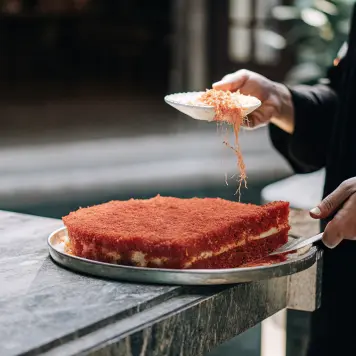
Knafeh
Knafeh is a beloved dessert made with thin shredded phyllo dough or semolina, layered with sweet cheese and soaked in sugary syrup. It is often served warm and bright orange from food coloring, especially in Jerusalem's Old City.
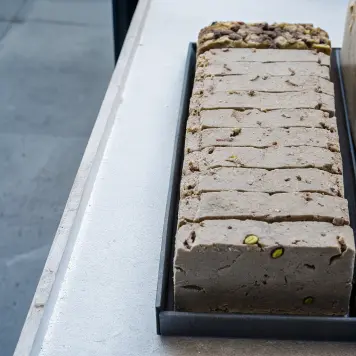
Halva
Halva is a dense, crumbly confection made from sesame paste and sugar, often studded with pistachios or chocolate. In Jerusalem, it is sold in specialty shops that slice it fresh from giant blocks.

Rugelach
Rugelach are small, crescent-shaped pastries rolled with fillings like chocolate, cinnamon, or fruit preserves. Jerusalem bakeries are especially famous for their flaky, buttery versions of this treat.
Tradiciniai sūrūs patiekalai
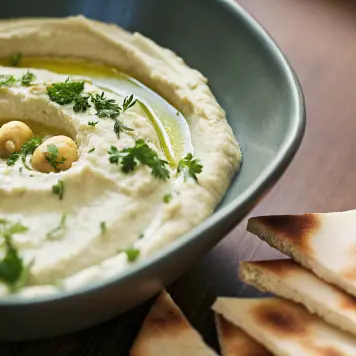
Hummus
Hummus is a creamy dip made from chickpeas, tahini, lemon, and garlic, served with warm pita bread. Jerusalem is home to legendary hummus eateries where locals argue passionately over which restaurant makes the best version.
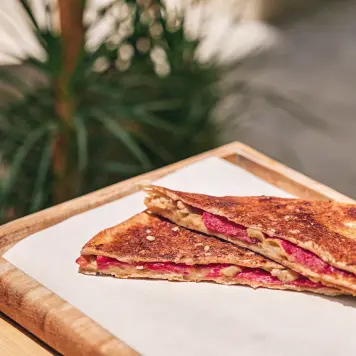
Musakhan
Musakhan is a Palestinian dish of roasted chicken, caramelized onions, sumac, and pine nuts layered over taboon bread. It is considered a national dish and is especially popular in Jerusalem and the West Bank.
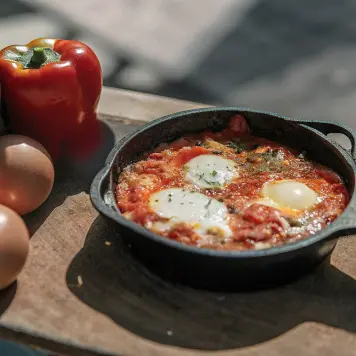
Shakshuka
Shakshuka features eggs gently poached in a spiced tomato and pepper sauce, often served in a cast iron skillet. In Jerusalem, it is a staple breakfast dish enjoyed in cafes throughout the city.
Tradiciniai gėrimai
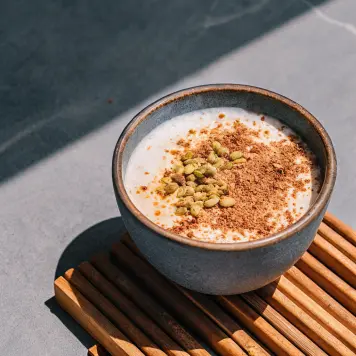
Sahlab
Sahlab is a thick, warm milk drink thickened with orchid root powder and flavored with rose water or orange blossom. It is topped with cinnamon, coconut, and crushed pistachios, making it a cozy winter favorite in Jerusalem.
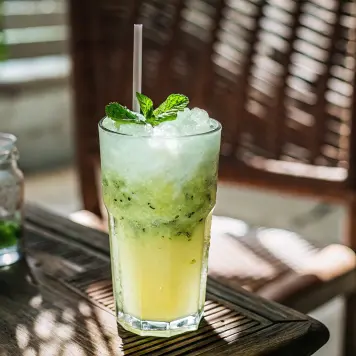
Limonana
Limonana is a refreshing blend of fresh lemon juice, mint, sugar, and crushed ice, similar to a lemonade slushie. It is the quintessential summer drink sold by street vendors all over Jerusalem.
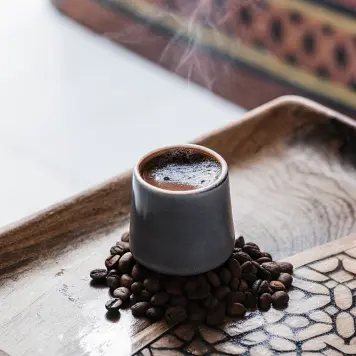
Turkish Coffee
Turkish coffee is made by boiling finely ground coffee beans with water and sugar in a small pot called a cezve. In Jerusalem, it is traditionally served with the grounds settled at the bottom, and the foam on top is considered a sign of quality.
Frequently Asked Questions about Jerusalem, Israel
Is Jerusalem, Israel safe?
How many days in Jerusalem, Israel?
Best time to visit Jerusalem, Israel?
Is Jerusalem, Israel expensive?
How to get around Jerusalem, Israel?
Gaukite PDF su populiariausiomis lankytinomis vietomis į savo el. paštą
Gaukite PDF su visomis lankytinomis vietomis, įvertinimais ir patarimais. Puikiai tinka naudoti neprisijungus.
Populiariausios dienos išvykos
Tel Aviv
Vibrant coastal city with beaches, nightlife, and modern culture
Dead Sea
Lowest point on Earth, famous for floating and mineral mud
Masada
Ancient fortress with dramatic views and UNESCO heritage status
Bethlehem
Biblical birthplace of Jesus with the Church of the Nativity
Kaip nuvykti
Oro uostai
Geležinkelio stotys
Tel Aviv, Herzliya, Ben Gurion Airport
Tel Aviv, Ben Gurion Airport, Modi'in
Take the direct train from Ben Gurion Airport to Jerusalem Yitzhak Navon Station in about 50 minutes. Taxis and shared shuttles also available.
Raskite skrydžius į Jerusalem, Israel
Spustelėkite, kad gautumėte eSIM Jerusalem, Israel
Lengviausias ir prieinamiausias būdas gauti mobilųjį internetą bet kur keliaujant.
Komentarai (7)
Food was incredible everywhere we went. Hummus at Abu Shukri changed my life. Only downside was prices near the Jaffa Gate, felt like tourist markup for sure.
Best part was just wandering the alleys in the Christian Quarter. Peaceful and beautiful in the early evening light. Three days felt like enough to see the main things.
Big tip: get a Rav Kav card for public transport. Buses to Bethlehem and the Mount of Olives cost like 6 shekels instead of 80 for a taxi. Top up at any train station.
Honestly found Jerusalem overwhelming and not in a good way. Too many religious tourists, pushy vendors, and the heat in July was brutal. Glad I went but wouldn't return.
Loved the mix of cultures everywhere you go. One minute you're in a market, the next in a silent church. Really unique place but bring good walking shoes, hills are no joke.